I spent 180 days at a standing desk to see if the workflow hype matches reality.
For my hybrid week, the bottleneck was afternoon lethargy. A standing desk mitigates this, provided you enforce a strict posture routine. If you expect a permanent cure for back pain without adjusting your monitor height or managing cables, save your money. My confidence is medium on the overarching hardware hype.
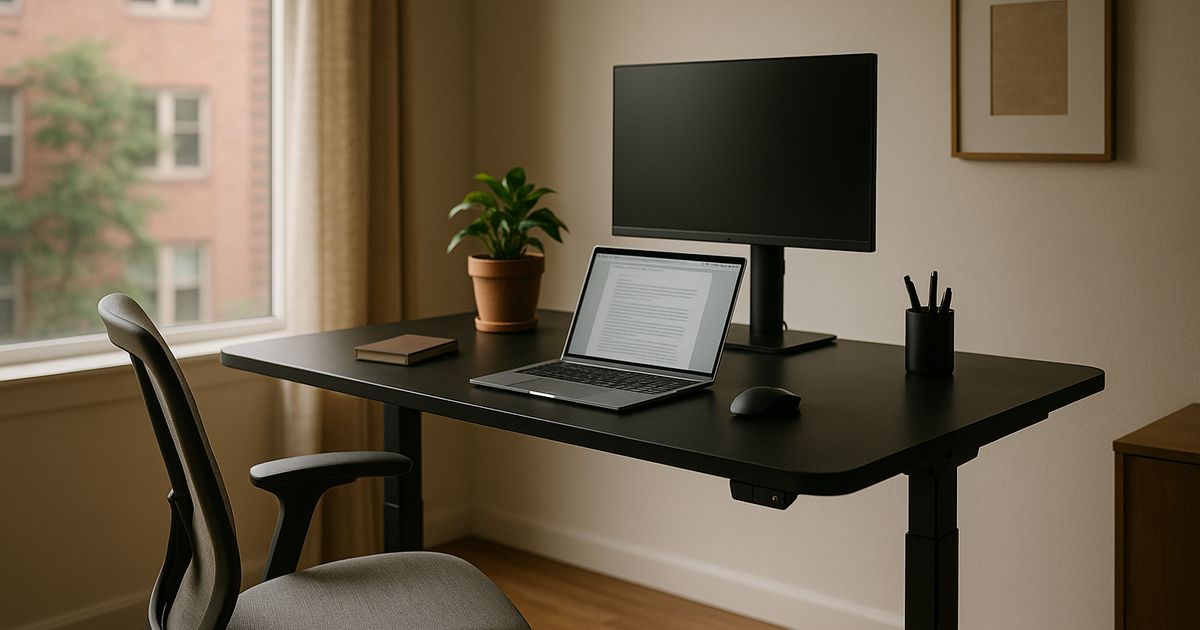
Why I bought it (context + expectation)
In my Seattle hybrid rhythm I tested a mid-tier electric standing desk because my 3 days home / 2 days office schedule was wrecking my lower back. The desk zone in my Capitol Hill 1BR apartment is exceptionally small; footprint matters immensely. My partner and I set a joint purchase threshold of ~$450, which meant skipping the ultra-premium $1,000 dual-motor behemoths. I needed a compact frame that supported my macOS workflow and external display without dominating our tiny living room.
How long I used it (timeline + frequency)
I ran this experiment over 180 days, spanning roughly a dozen sprint cycles. On hybrid weeks, I noticed the physical toll primarily during office-to-home transitions. Dragging myself to a static sitting desk after a commute was creating unnecessary friction. By month three, the novelty of pushing a button to elevate my workstation completely faded, leaving behind only the raw, measurable utility of the desk's mechanics.
Is it worth it (real gain)
I measure output, not gadget excitement. A Texas A&M study claims a 10% productivity boost for standing desk users, which sounds great in an academic vacuum. In practice? I measured this in meetings per week, not specs. The tangible return on investment wasn't a sudden spike in code shipped or Jira tickets closed. Instead, I saw a sharp drop in 3:00 PM brain fog and improved circulation. That said, quality electric standing desks often cost between $500 and $1,000. Hitting our $450 budget meant compromising on integrated cable management and built-in power banks, which added peripheral costs later.
Pitfalls (hidden costs + friction)
It was a standard Tuesday morning, right before a 9 AM standup call. I hit the memory preset to raise the desk to standing height, and my MacBook charger violently ripped out of the wall socket, taking my external dock offline mid-sentence. If setup steals Monday morning, I reject it.
The immediate pitfall is cable drag. You have to account for cord length since standard cables are simply too short for a 40-inch vertical rise. Second, standing for extended periods triggers severe leg fatigue and lower back strain. I mistakenly treated it as a marathon initially, which completely backfired. Finally, uneven load distribution—like clamping a heavy monitor arm entirely to one side—can cause the lifting gears to misalign and emit a highly distracting mechanical whine when transitioning heights.
Long-term changes (30/90/180 days)
By week four, I tried standing through three hours of consecutive Zoom reviews. By 4 PM, my lower back stiffness flared up so noticeably I had to lie down on the floor. I optimize for fewer context switches, but my body forced me to mandate position changes.
This only works when meeting load is normal. I eventually implemented a rigid sit-stand routine: standing for just 20 to 30 minutes per hour, then lowering the desk. I also added a cheap footstool under the desk to rest one foot at a time, which dramatically cut down joint stress. Adjusting the monitor so the top third of the screen sat just below eye level—exactly 24 inches away—eliminated my residual neck strain. My baseline is calm focus, not peak hype, and dialing in these micro-adjustments finally achieved that.
Who this is not for (clear boundary)
Skip this hardware if you lack the discipline to alternate postures. Standing all day is just as physically detrimental as sitting all day, leading to joint stress and varicose veins over time. It is also a terrible fit for anyone relying on a fragile daisy-chain of single-purpose dongles. The vertical movement will inevitably snap a loose connection. Furthermore, if your maintenance tolerance is zero and you cannot spare 60 minutes to securely zip-tie your power bricks to the frame, the cable anxiety will infuriate you.
Alternatives (safer options)
If your floor plan is even tighter than mine, a standing desk converter is a highly functional fallback. Compact portable risers sit directly on top of your existing table and cost a fraction of a dedicated motorized frame. Alternatively, if you despise standing entirely, taking that $450 and investing it into a premium, highly adjustable ergonomic sitting chair will likely yield better spinal support.
One-line verdict (would I buy again?)
I keep tools that disappear into routine; net focus gain was positive, so I kept it.
Related navigation: Ryan persona channel, workspace-ergonomics cluster, hybrid-work-home-office scenario.