Why I stopped buying ultra-compact fast chargers for my commute
I do not recommend chasing the absolute smallest fast-charge bricks. Between heat issues and sudden failures, downsizing too aggressively compromises your hardware. If you run a USB-C-first mobile office, prioritizing a slightly larger, thermally stable GaN charger is mandatory.
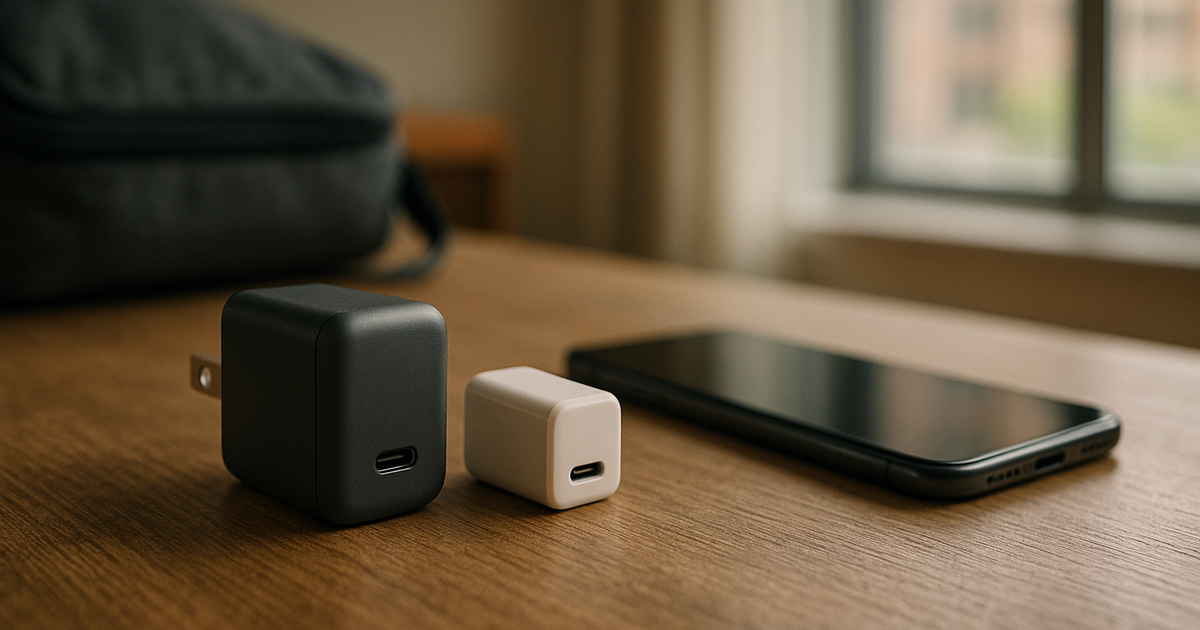
Why I bought it (context + expectation)
On cross-city commute days, dead weight is my enemy. Tuesday morning, 7:15 AM on the Caltrain platform. I pulled out a standard OEM brick to top up my phone before a critical status meeting. It was completely dead—a known issue with some standard bricks failing without warning after just six months. My mornings are won or lost in small delays. I immediately realized I needed to rebuild my charging system.
Weight reduction is a measured priority for me, where every gram matters, but carrying a broken charger is just hauling an anchor. Portable is not optional for me. I began hunting for ultra-compact GaN chargers, assuming the smallest possible physical footprint would perfectly optimize my daily carry load.
How long I used it (timeline + frequency)
I spent three months rotating through 30W to 65W micro-bricks. This included budget mini options and premium models like the Rolling Square Supertiny. Testing happened exactly where the gear must perform: train tray tables, airport lounges, and temporary rental desks.
Still validating under delay-heavy weeks, I tracked charging speeds versus thermal output. A tiny 65W brick delivering laptop-level power sounds ideal. Yet, the tradeoff is usually thermal stability. Real-world transit lacks perfect ventilation.
Is it worth it (real gain)
Buying a charger purely based on minimal dimensions is not worth the tradeoff. I value reliability over extra modes. When manufacturers shrink components to the absolute limit, heat dissipation suffers heavily.
A severely overheated brick throttles charging speeds to protect itself. This means your critical 15-minute transfer window yields almost zero battery recovery. Because my high-stakes job means downtime cost is incredibly high, I cannot afford to land at a client site with a laptop stuck at 12 percent just because my micro-charger decided to thermal throttle.
Pitfalls (hidden costs + friction)
Between train changes last Thursday, I grabbed a coffee in San Francisco and plugged a tiny, unbranded travel charger into a wall socket. Twenty minutes later, it was dangerously hot to the touch, and my device stopped charging entirely. Commute friction compounds fast. Using a charger not suited for the exact power draw causes overheating, which can lead to short circuits and tripped breakers.
Incompatible chargers delivering mismatched voltages risk component failure and severe fire hazards. Furthermore, micro-bricks often require you to tightly fold cables into tiny accessory pouches. Tight bends inside a crowded bag impair internal wiring. This creates resistance that generates even more heat during use.
Long-term changes (30/90/180 days)
Sunday night is my weekly staging period. While repacking my bag in my apartment, I inspected my tightly folded charging cables and noticed a slight fray near the connector. If setup takes too long, it fails in real life. But rushing the teardown and crushing cables into tight pockets creates physical damage.
My approach to mobility shifted entirely after that. I stopped hunting for the absolute smallest physical footprint. Instead, I started optimizing for thermal efficiency and cable health. I treat failure points as reliability tests. Now, I allocate slightly more space for a properly sized multi-port GaN charger and loosely coiled cables.
Who this is not for (clear boundary)
This analysis is not for anyone working from a fixed home desk where a charger never moves. It is also irrelevant for users who only charge their devices overnight on a nightstand. If you do not track your transfer times or carry a strict USB-C-first mobile office, the nuances of GaN thermal throttling will not impact your daily routine.
Alternatives (safer options)
If you need a functional baseline, shift your focus to slightly larger, multi-port GaN options. The Anker 735 Nano II 65W 3-Port Charger is a solid compromise. It handles a wider range of devices and maintains simultaneous charging without hitting critical temperatures instantly.
Alternatively, the Journey 30W Mini Charger offers safe power delivery for smaller devices, provided you strictly separate your phone and laptop power streams. If it cannot survive peak-hour chaos, I move on.
One-line verdict (would I buy again?)
If it slows my route, I drop it—stop buying undersized bricks that overheat, and invest in a thermally stable GaN charger.
Related navigation: Priya persona channel, mobility-commute cluster, frequent-relocation-rental scenario.