I tried consolidating with a wet-dry vacuum for 150 days. Here is why I went back to basic tools.
First question: how many cubic feet and how many minutes per week? If you have unlimited closet space and enjoy cleaning your cleaning tools, a wet-dry combo might work. For apartment dwellers, the maintenance and physical bulk turn a convenience appliance into a liability.
Why I bought it (context + expectation)
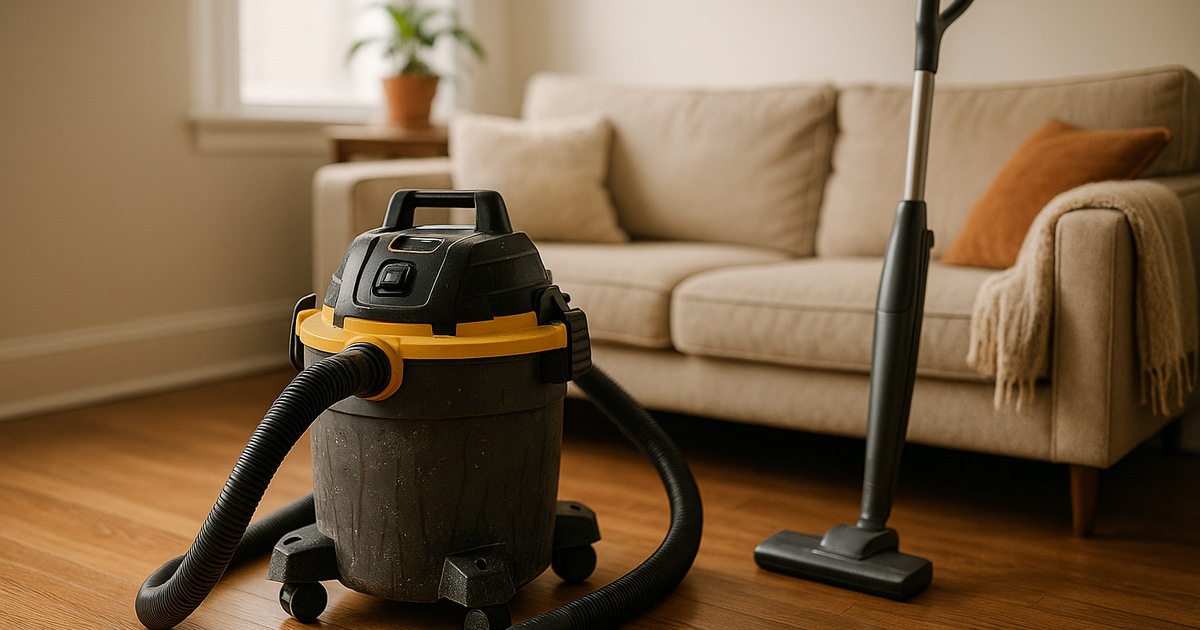
In my Portland studio, I adhere to a strict one-in-one-out rule for gadgets. I thought a wet-dry vacuum combo would be the ultimate consolidation. I wanted to handle spilled liquid and routine floor dust with a single cylinder. The theory was sound. Less gear, fewer steps. I chose a standard compact wet-dry model to replace a failing stick vacuum and a traditional mop. I envisioned an entirely streamlined weekend routine.
How long I used it (timeline + frequency)
It was a rainy Tuesday. I tried to quickly clean up some tracked-in mud near the entryway. The machine sputtered. It shut off entirely. The internal filter was completely clogged with damp dust from a dry run three days prior. I had to disassemble the dirty drum right there on my floor.
150 days. That is exactly how long I kept this experiment going. I tracked the time spent emptying the water tank. I logged the minutes spent unclogging the hose. I monitored how long it took to air-dry the filters to prevent mold. The math did not align with my life.
Is it worth it (real gain)
No. Space is my primary budget. The footprint cost was simply too high.
The unit was not just a vacuum. It was an expanding web of attachments. It came with a 10-foot power cord and a rigid 7-foot hose. Finding a place for those components required constant rearranging. One extra accessory can be one too many. Consolidating two tools into a single massive drum did not simplify my space. It complicated it.
Pitfalls (hidden costs + friction)
Month four, Saturday morning. I opened my single storage closet to grab a coat. A massive, rigid vacuum hose fell out and hit my shoulder. I realized I was actively giving up living space to store plastic tubes.
The risks of this category are systemic:
* The maintenance loop: Restricted airflow causes these motors to overheat easily. Rinsing the internal filter and waiting for it to dry took constant oversight. My absolute maintenance cap is 40 min/week total. This machine demanded half of that just to maintain itself.
* Failure points: Wet-dry vacuums rely on perfect drum seals. If a gasket degrades or is seated slightly off-center, dirty water leaks directly onto the floor you just cleaned.
* Storage hostile: A bulky cylinder shape is the hardest thing to store in a small footprint.
Long-term changes (30/90/180 days)
I remove before I add. After pulling the plug on the combo experiment, I realized I needed dedicated, simple items. A tool must lower cognitive load, not raise it.
I went back to a lightweight dry vacuum. I went back to a basic flat mop for wet spills. Two very small tools take up significantly less physical volume than one massive combo unit. My closet has clean lines again. Clean lines matter because habits follow environment.
Who this is not for (clear boundary)
This category fails for renters navigating studio living + move every ~18 months risk. Lugging a dirty, bulky cylinder from apartment to apartment is irrational.
It is also a poor fit for anyone who hates ecosystem lock-in. If it needs a second gadget to work, it’s out. If it requires proprietary replacement filters just to maintain baseline suction, skip it. Anyone with a strict cap on weekly household chores should avoid this format entirely.
Alternatives (safer options)
Instead of a massive combo unit, I pivoted to ultra-lightweight dry vacuums. Minimal does not mean underperforming.
The BISSELL Featherweight Stick weighs just over 3 pounds. It handles daily hard-floor dust flawlessly and tucks behind a door. Alternatively, the Eureka Mighty Mite is a highly compact canister. It is vastly easier to store than a typical 6-gallon wet-dry drum. Both options cost well under my $260 single-purchase threshold. For wet messes, a standard flat microfiber mop is silent, requires zero electricity, and has no motor to overheat.
One-line verdict (would I buy again?)
Consolidating two functions into one high-maintenance machine is a false economy. If it adds another workflow, it goes.
Related navigation: Eva persona channel, home-cleaning cluster, frequent-relocation-rental scenario.